Deep inside the emerald depths of Kibale National Park, one of Africa’s most complex social dramas is unfolding.
This is not the predictable calm many imagine in a rainforest. It is structured chaos. Strategy. Loyalty. Betrayal. And survival.
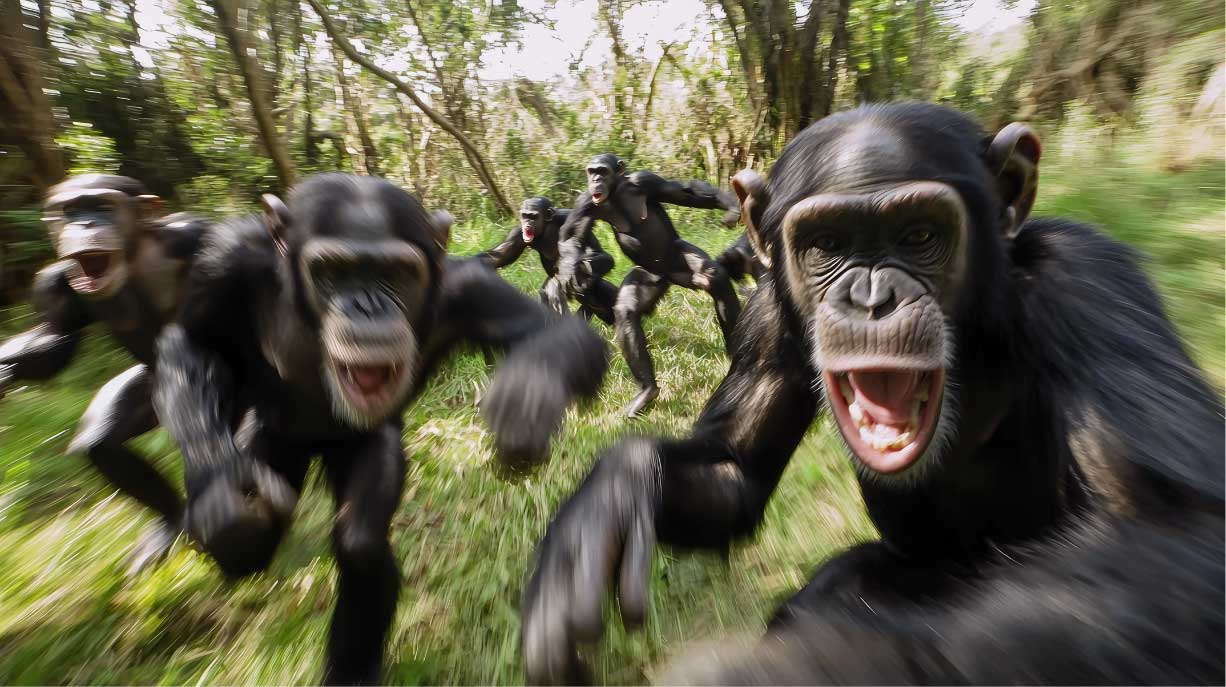
Recent long term scientific observation has revealed that chimpanzees here are not only intelligent and social, but capable of sustained, organized conflict between rival factions, often described by researchers as “chimpanzee warfare” or even “civil war” due to its scale and coordination (The Guardian).
What appears as simple aggression from a distance is actually a deeply layered struggle for dominance, territory, and reproductive control.
A Society Built on Power and Alliance
Chimpanzees in Kibale live in fission fusion societies, meaning the community constantly splits into smaller groups and reforms throughout the day depending on food availability, relationships, and risk.
Within this fluid structure, dominance is never fully stable.
At the center of it all are high ranking males who form alliances, patrol boundaries, and influence access to resources. But alliances shift. Trust breaks. And when social balance collapses, entire communities can fracture into rival factions.
Recent studies of the Ngogo chimpanzee community show how a once unified group of over 200 individuals split into two factions that eventually turned against each other in prolonged violent conflict (Wikipedia).
The Fight for Supremacy
Chimpanzee conflict is not random violence. It is targeted, coordinated, and strategic.
When tensions rise, males conduct border patrols deep into contested territory. These patrols are silent, deliberate, and highly coordinated. Encounters with rival groups are often ambush styled rather than accidental.
Victims are usually isolated individuals caught away from their group. Attacks are swift and overwhelming, involving multiple aggressors acting together.
What emerges is not chaos, but a system of calculated dominance aimed at weakening the opposing faction over time.
Why These Conflicts Begin
The reasons behind these violent splits are complex, but researchers identify several consistent triggers:
Group size reaching unsustainable levels, increasing competition for food and mating access
Loss of key individuals who previously held social factions together
Leadership transitions that destabilize existing alliances
Territorial pressure between neighboring chimpanzee communities
In Kibale, one of the largest studied chimpanzee communities experienced these exact pressures before splitting into rival groups, leading to prolonged conflict and territorial expansion by the dominant faction (Wikipedia).
The Role of Territory and Survival Advantage
At the core of these conflicts is one reality: territory equals survival advantage.
Groups that successfully dominate rivals gain access to larger feeding grounds, which improves nutrition, reproductive success, and infant survival rates.
In long term studies of Kibale chimpanzees, victorious groups experienced measurable population growth after expanding their territory, showing a direct link between conflict outcomes and reproductive success (Live Science).
This makes the struggle for dominance not just about power, but about genetic continuation.
Violence That Mirrors Human Structure
What makes these conflicts so striking to scientists is not just their intensity, but their structure.
Attacks are not random. They are strategic. Patrols resemble military reconnaissance. Group coordination reflects planning and shared intent. Even the timing of raids appears deliberate.
Some researchers describe these patterns as one of the closest natural parallels to early forms of organized warfare seen in human evolution (The Times of India).
Yet despite the comparisons, this remains a purely ecological process shaped by survival pressures rather than ideology.
Witnessing the Forest Beyond the Conflict
For visitors exploring Uganda through Davema Tours and Travel Solutions, Kibale is not presented as a spectacle of violence, but as a living ecosystem where intelligence and survival intersect.
Chimpanzee tracking experiences reveal something far more profound than conflict. They reveal family structures, caregiving behavior, play, cooperation, and emotion.
The same species capable of territorial aggression also shows tenderness, problem solving, and deep social bonds within its groups.
Final Thought
In the heart of Kibale National Park, chimpanzees are constantly negotiating survival.
Sometimes through cooperation. Sometimes through conflict.
Their struggles for supremacy are not simply battles for dominance, but reflections of how deeply social intelligence can shape life in the wild.
And for those who witness it firsthand, one truth becomes clear.
Nature is not peaceful or violent.
It is strategic.